
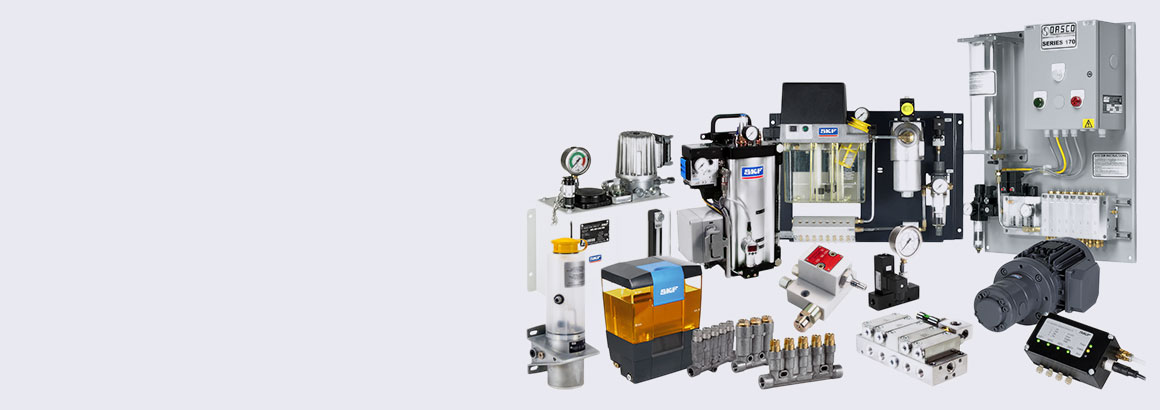
Central lubrication systems are designed to supply individual lubrication points and groups of points with varying lubricant requirements from a central location with the necessary, precisely metered quantities of lubricant. Oils and greases of NLGI grades 000 to 3 are used as lubricants. Careful installation, commissioning, and maintenance of the central lubrication system contribute to increased operational readiness and the service life of the machines. The central lubrication system deserves the same attention as all other high-value components of a machine. Our many years of experience in central lubrication technology for machines and systems will help you solve your problems in planning, lubricant selection, and application. Central lubrication systems are classified according to their function and method of lubricant distribution. We would be happy to advise you!

Single-line lubrication system
In single-line lubrication systems, fresh lubricant (oil, grease, or semi-fluid grease) is continuously supplied to the friction points at specific intervals (dependent on time or machine cycle) during the lubrication cycle (contact time, pump runtime). The amount of lubricant supplied is measured so that the friction points are supplied with lubricant during the pause time to build up a sufficient lubricating film. Over time, the lubricant is partially consumed in the friction point due to aging, evaporation, bleeding, and leakage (total loss lubrication).
Heat dissipation is not possible with this lubrication method. Other terms for total loss lubrication systems are common in the literature and catalogs, e.g.:
• Total loss lubrication
• Continuous lubrication (in DIN ISO 5170 [total loss lubrication])
• Fresh oil lubrication.
Central lubrication units are manually, mechanically, electrically, hydraulically, or pneumatically operated piston pumps or intermittently driven gear pumps. The lubricant is metered by piston distributors mounted in the pipeline network. Interchangeable metering nipples on the distributors allow the required amount of lubricant to be supplied to each lubrication point per stroke or pump cycle.
The metering range is from 0.01 to 1.5 cm³ per lubrication pulse and lubrication point. The amount of lubricant supplied to the lubrication points can also be influenced by the number of lubrication pulses. With multi-point lubrication systems, an oil return from the lubrication point to the oil reservoir is not required.
The single-point multi-point lubrication system always has the same basic structure:
–Pump, piston distributor,
–Main pipeline (connection: pump – distributor),
–Lubrication point line (connection: distributor – lubrication point).
Automatically operated systems also include control and monitoring devices, pressure switches, float switches, and indicator lights.
